The Birth of the Balti

In the 1950s and 1960s, Birmingham was renowned for its manufacturing prowess, but unlike today, its food scene was far from being recognised as one of the city's defining strengths.

While "going for a curry" was a universally popular pastime,  it was largely associated with couples or more frequently groups of men looking for food after an evening out.  Meanwhile, the areas of Sparkhill, Sparkbrook and Balsall Heath were welcoming  growing Kashmiri communities, leading to the opening of numerous cafés and restaurants that would in the 1990’s form what became known as 'The Balti Triangle'.

One restaurateur, Mohammed Arif, owner of Adil on Stoney Lane, saw an opportunity to introduce local Brummies to a new style of curry. While his restaurant primarily served the local Kashmiri community, he recognised that Birmingham diners already had a taste for curry, largely through licensed Bangladeshi and Bengali restaurants. Knowing that many customers preferred boneless meat and expected their meals to be served quickly, he developed what became known as the Birmingham Balti.

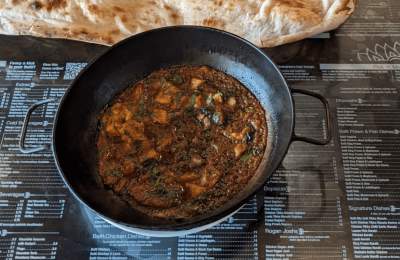
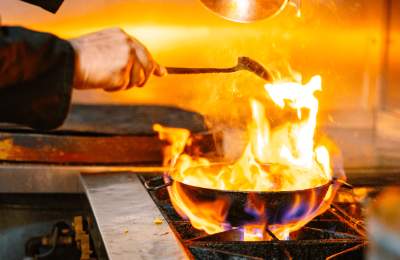
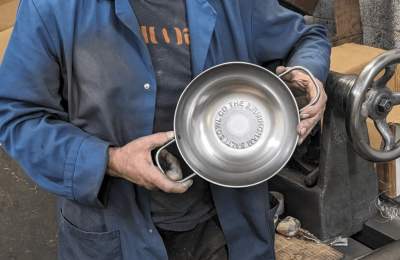
His mission took Mohammed over to the Birmingham/ Smethwick border where a Sikh engineer agreed to make some flat bottomed, flat handled pans which would be stable on a high flamed burner so cooking the 'curry' could be quick... rather than a typical Kashmiri slow cooked 'stewed on the bone' dish. The 'Balti' pan was made of thin pressed steel so the contents could cook very quickly and was deliberately not coated, so that the pan could build up layers of flavours. (Indeed, on the latter point, many genuine Balti restaurants are still using blackened pans over twenty years old!) Vegetable oil was substituted for ghee on the basis that ' Brummie' diners would prefer their 'Balti' cooked in a healthier manner!

Incidentally Arif coined the use of the world 'Balti' (The Urdu word for 'bucket') as he thought not only was it easy to say and catchy, but it actually related to the food ' buckets' used at Muslim weddings. 

Interestingly, many of these new ' Balti goers' started to enjoy naan breads and chapattis instead of rice which reflected the eating habits of the Kashmiris. An extra bonus, of course, was that none of these new waves of ' baltihouses' were licensed due to the Muslim traditions so diners could just bring in their own tipple.

The Birmingham Balti was born!


The Birmingham Balti -The Boom Years

Whilst Balti was a culinary creation dating back to the 1970s, its halcyon period was in the 90s where in the Balti Triangle area alone there were between 20 and 30 authentic Balti restaurants, nearly all family ran.

It reached the stage when the age old icebreaker between comparative strangers of talking about the weather was replaced by the opening line of 'Where do you go for a Balti?'

Often featured in the National papers , the city's Balti Triangle even made an appearance in the Rough Guide's one hundred things to do before you die....even beating ' Seeing the Eiffel Tower'! Interestingly many newspapers initially referred to the area as the Balti Belt but its local name of the Balti Triangle was soon adopted perhaps because it was more tourism friendly. The name was due to the rough triangular shape of the area with the biggest concentration of Baltihouses.

Further fame followed when there was even a sell-out play produced entitled ' Balti Kings'. Bizarrely Birmingham City Council's Environmental Health Team investigated Balti as a possible health threat because of people using a naan bread or chapatti to eat with instead of a knife and fork!

A pocket Balti Guide followed featuring all the restaurants and at just a pound it became a best seller in the local Waterstones. An appearance at the BBC Good Food Show followed, to the chagrin of a couple of famous TV chefs who insisted the dish was an invention. Which, of course, is like all good dishes... just a product of culinary evolution.

Then Balti became such a byword that curry restaurants all over the UK started to put it on the menu  but unfortunately many just cooked  the ingredients slowly in a frying pan before transferring to a silver bowl.....absolutely not a Balti! 

So the campaign started to get the authentic Birmingham Balti recognised.


Future Proofing Birmingham's Signature Dish!

In looking to both badge and safeguard Birmingham's famous culinary creation, the key was to compare a proper fast cooked Balti both cooked and served in a thin pressed steel dish with a pseudo Balti that is a slower cooked curry served up in a silver serving dish.

The University College Birmingham were asked to undertake a comparison and after a detailed check by an approved food analyst, it showed that an authentic Balti had substantially less saturated fat, had over twice the amount of iron (the most valuable element for the human body) and produced the Mallard effect which is a caramelisation effect which Michelin chefs prize.

Off the back of those tests a bid was made to the European Union for their prized food award of ' Traditional Speciality Guaranteed'... already awarded to the Arbroath Smokie and the Melton Mowbray Pork Pie. However, whilst the Birmingham Balti bid was approved by the vetting government department, DEFRA, and was sent onto Brussels, in the midst of the Eurocrats appraisal, the UK decided to leave the EU and strike out on its own. 

This left the EU bid in a state of limbo and whilst the UK decided to develop a similar food mark, a plea to DEFRA (the new government department taking the lead), their view was that Balti was in such common usage it couldn't be safeguarded.

The campaign to protect Birmingham's iconic Balti has since taken a new direction. Following approval from UNESCO, the UK has established its own Trail of Intangible Cultural Heritage, recognising traditions of national cultural significance, including food and drink heritage.

After initial discussions, the Association for the Protection of the Authentic Balti (APAB) was invited to submit an application for recognition. The process is divided into three stages, and the bid has already successfully passed the first. If ultimately successful, the designation would help safeguard the authentic Birmingham Balti while recognising its cultural significance and securing its place as an important part of the city's culinary heritage.

The APAB campaign has also attracted the backing of a number of well-known figures, with endorsements featured on the organisation's website. 


Try one for yourself, find some of Birmingham's best Balti restaurants here